How to set up your tech light system
Media Reports
Do you know how to set up your tech light system when you start your tech dives?
1. Start with what you have
If you’re starting from recreational diving, you don’t need to buy everything immediately. You can look for what you have that can work. Most times, only a goodman handle or the wrist strap is needed to start. However, most divers quickly realize the need for a more powerful dive light with Longer burn time, a more focused beam, and hands-free operation.
This is why divers typically upgrade early to a canister light system
So why Lighting Is Critical in Technical Diving?
In recreational diving, a torch is often optional. In technical diving, it is life-support equipment.
A failure in your lighting system—especially in overhead environments—can escalate rapidly into a critical incident.
So that's why people always follow a principle in tech diving, “One is none, two is one, three is standard.”
2 . The Primary Dive Light
If you dive with a longhose you need a canister light. A good canister light separates the battery from the light head, giving you more burn time, better balance, and clean hose routing.
For the primary dive light, we usually need a light that has enough burn time for the planned dive, most say at least 1.5 times the planned dive time. Lumens need to be enough to see what you want to see, and a small beam for communication, most at 5 - 10 degrees. In clear water, a 1000 lumen can be enough, whereas 3000 is needed in murky waters.
And yes, if you don’t yet have a canister light, you can also use long hose retainers, which you can buy from the market or alternative routing methods, but these are transitional solutions, not a long-term choice. On the other hand, more and more people are pinning their hopes on handheld lights. They expect that batteries in handheld lights will become better soon.
How to set:
* Canister (Battery Pack): mounted on the right waist belt, acts as a physical anchor point for your long hose.
You can use the one that works for both sidemount and backmount. This setup is more flexible for your needs. OrcaTorch D630 v2.0 features an adjustable-angle cable 1.2m, supporting both two ways.
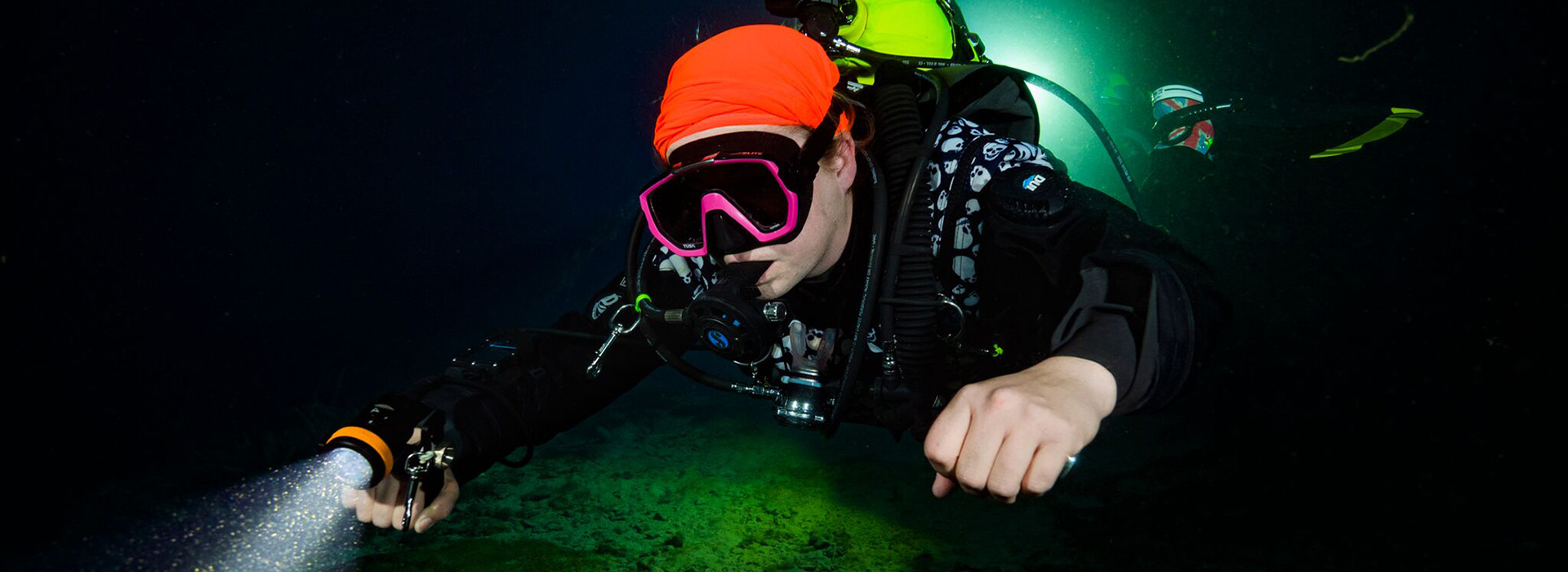
* Light head: Usually we worn on the left hand with a Goodman handle, this way can keep your right hand free for things like Stage/deco handling, DPV control, etc.
Now, most backup lights are as clear as main lights, so it is not that important anymore.
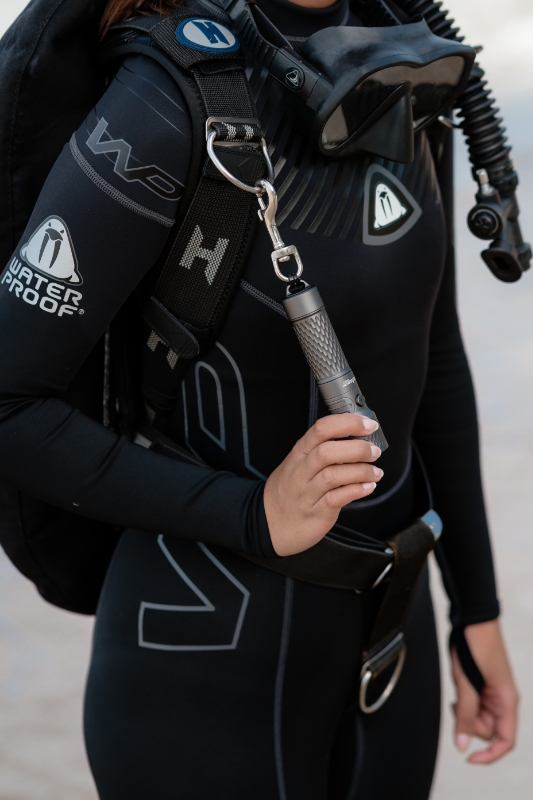
In open water tech/deco diving: at least 1, but for cave or overhead environments, need 2 backups. They need to be small enough that they can be clipped to the left and right chest D-rings using the bolt snap.
As shown in the picture, we put the Orca 7 on the D-rings. This set can make a one-handed deployment.
About the time, it always depends on your dive; most people around 60-90 minutes, but in Mexico is more, caves are shallower, and the water is warm. So let's say at least 700 lumens to have a normal backup light to guide you for at least 3 hours. OrcaTorch small torches, like Orca 7, D710, or the D530, all of them can work.
4. How to maintain your torch
4.1 O-Rings: To keep the o-ring and thread rotating smoothly, wipe silicone grease on the surface 2-3 times a year, depending on your times to diving. Besides, when replacing the bezel, do not require excessive force, and you just need a snug twist.
4.2 After your dive: remember to clean your underwater torch, use fresh water to rinse your torch to remove all salt or sand, and do not use a cleaning agent, as it will do harm to your light. While submerging, operate switches 5-10times to work saltwater, grit, etc out of the switches.
4.3 Battery Management. Always start dives at 100% charge.
Start simple, upgrade smart, and always prioritize function over power.